The places you have walked
You in everything, Gang of Youths.
I consider holy ground
And I will love the things you love despite my prior thoughts about –
In an album replete with songs reflecting his father’s passing, I was struck by David Le’aupepe’s lyric. For me it speaks of a question that many of us may have asked: What exactly do we do with the stuff – and more specifically, with the meanings – that our loved ones pass to us – or leave behind?
I remember my parents 40ths so clearly. Dad’s: A BBQ at home. The balcony full of friends and family. Cake, iced with white and piping of bright blue. Speeches for and by Dad. The family photo that was taken that day lives rent free in my head, in prime position.
Mum’s 40th was an even bigger deal in the family history; it was an evening, adults-only party, downstairs in the garage. My sister and I spent weeks learning Scottish dances to perform. (Don’t ask me why: Zero Scottish heritage in our family). Everyone had a brilliant time. And the pièce de résistance: Mum’s American best friend appearing on the doorstep, a surprise for her. Again, core memories.
What we remember about our childhood shapes us. How we see our parents mark their time leaves an (often unarticulated) mark on us. What is meaningful to them often gets passed on as meaningful to us.
I’ve been thinking about these parties, these memories, so much of late. Because I too will be joining the ranks of the 40 tribe this week. It stands to reason that I need to have a decent or at least memorable party to mark my “over the hill” moment, right? It’s the family tradition to do so.
I’m not at this time having a massive crisis of identity (I’ll report back if that does indeed manifest) but I keep thinking about those parties of my parents, thinking about how I’ve shaped my expectation and projection of my own 40th from their example- and I wonder- just how much do we pick up and carry of sentimental expectation from that which we witness? We may be the NPC (Non-Player Character) in these moments, witnessing rather than participating in what is occurring, but the impact of what we experience – even by the sidelines – can still be significant.
Tradition: Rituals of Inheritance
The inheritance of sentiment, of tradition, of values, can be a truly incredible thing. This is what cultures, communities, values, ethics are formed by- witnessing and embedding that which is holy, funny, sacred, of priority, reverential, honourable and just.
Values, rituals and traditions are generational mediums. They are the slow work of nuance and drama: they are reinforced over time. At best, they are incredible tools of meaning making.
But, at worst, they can also be tools of destructive meaning making. We witness & reinforce that which is shameful, hated, or excluded.
Even if they are ‘good’, the traditions we carry may be far heavier than we give credit to the carrier for; dripping with expectation, they can become burdens rather than privileges.
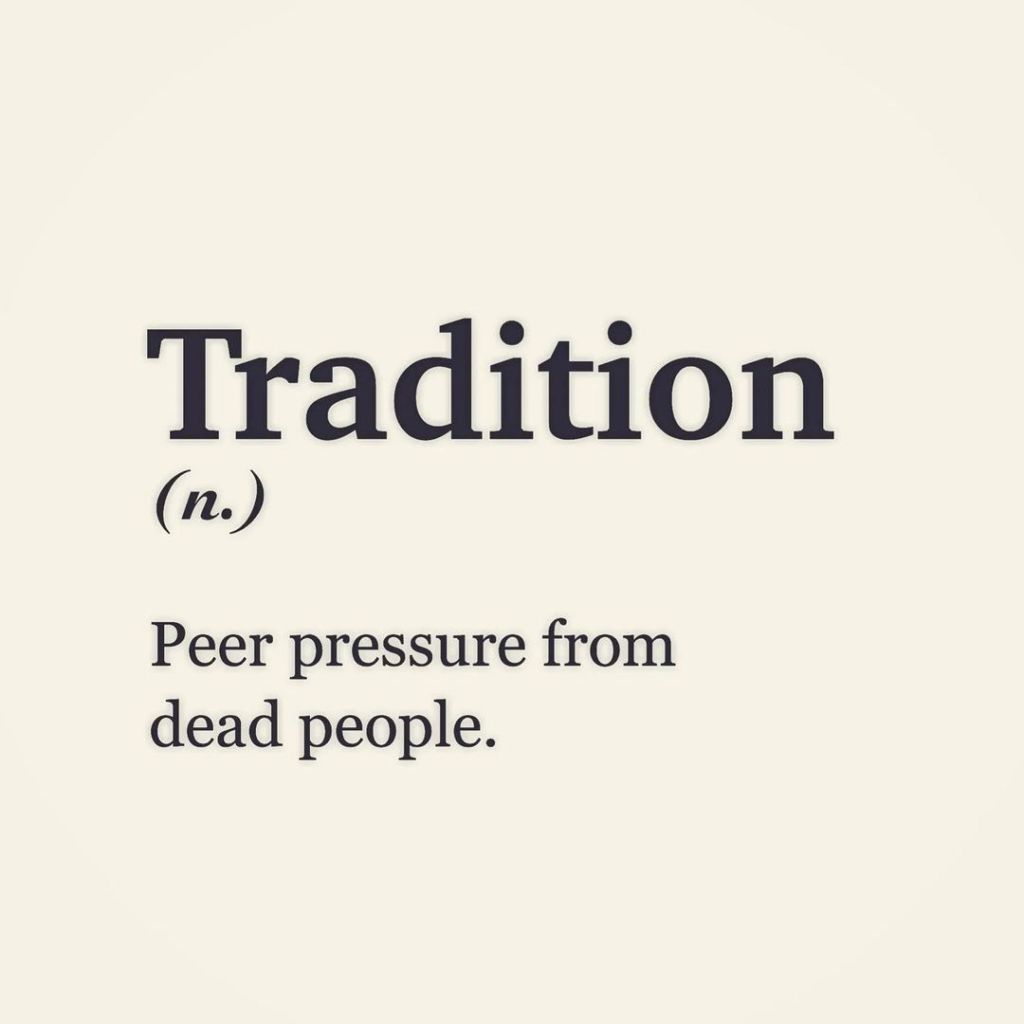
So, what do you bring? What expectations, some explicit, many implied, do you carry with you? Furthermore, which ones have you attempted to unload?
Why should we be held, indebted to practices which rise to symbolic and mythical status in our mind – when we often don’t a) know what the practice originally meant, or b) chose the tradition for ourselves?
For choice is the great prize – and key- here, hey. If we didn’t choose a practice, ritual, tradition or value requiring our time and energy, we are the losers* in the equation. [*according to dominant Western culture]
This is one of the reasons that I love sociology.
Where I see sociology as helpful for us all – is that we do have permission and the means to reflect, and reflect critically, the traditions and beliefs that influence our daily rhythms, and equally, those that underlay our values. Ones of family, ones of workplaces, ones of ethics, ones of faith, ones of society. Indeed, if I may be so bold, I believe that we have a responsibility to do so. If, after reflection, if, after understanding both the history and present-day reality of those traditions that we participate in, the audit can then help us understand and internalise these values, and then we can have the joy of claiming those traditions as our own. Likewise, if we investigate and reflect upon a tradition, but come to a place where we disagree with the fruit or meaning of a ritual, perhaps we can give ourselves permission to release ourselves of the expectation to continue that tradition, or at the very least, recognise the consequences of continuing to uphold that value.
If we are privileged positions of education, of public voice, discourse, relationship – don’t we also have the responsibility and privilege to know what our rhythms of life endorse?
Let me give you an example.
Education: both my parents left their family home and towns at an early age to come to town and study. My father was the first one of his family to ever complete tertiary and then post-graduate study. The gifts that education brought my parents led them to endorse education in their children’s lives. It was a given that I was going to Uni after school. Mum and dad saved for educational accounts. I didn’t question the option. And so after completing undergrad and honours, in 2006 I signed up for a PhD because I wasn’t doing anything else, which resulted in me spending a decade total as a student, and the following 15 years and counting as an academic at uni. It appears that I’ll never get rid of it.
Education: good, yes?
A tradition and value that is unequivocally good.
But. It does have a consequence. Flash forward to my 6-year-old once discussing her future prospects: “I think I’m going to become a scientist – or a hairdresser!”
The education-saturated part of me praised the stem choice, while also proclaimed that she would never pursue a career that didn’t include a degree.
Because here friends, is what tradition does. It instils values, embeds meaning – but also creates a world view and as a consequence, biases towards what is not valuable in that consequence.
I need to be aware of the power that these embedded traditions imbue upon me. Not that I need to reject it in this case: I certainly do still value and celebrate the power of education, especially of those populations who have historically been excluded from educational opportunities. But so too do I need to consider the consequences that those values have, and it is good practice for me to declare what those biases are.
Moreover, if we partner up and begin the life-long journey of creating marriages, families, households, if we insist on carrying – and rigidly implementing – ALL the values and traditions we grow up with, that is a pretty crowded space. Relationships thrive when we give ourselves permission – and space – to create something new between us. This is not an insistence for you to throw them all away – again, traditions are often wonderful – but your partner brings traditions too, and we need to be generous in respecting the value of their traditions just as much as our own.
As organisational psychologist Adam Grant argues,
“Peer pressure isn’t always a bad thing! [I’m] not suggesting that anyone disrespect or disregard the past – only that we’re thoughtful about when to preserve it and when it’s holding us back.”
Grant, (2021)
The ideals/values don’t have to be as lofty as education – why take another example: This is a stupid one, so stay tuned.
The Couch: Years ago, my mother bought a beautiful leather couch. She was so proud of the thing: it’s brown, comfortable, and as she declared “a Natuzzi!” My husband and I were lucky to have the couch when we were first married and furniture deficient, but it was so big that a window needed to be removed in order for it to fit into the house. When we moved into our new build, Shannon pleaded for me to get rid of the couch and not make him move it again; by this point we had bought new couches for our house, and the Natuzzi’s would be relegated to bedrooms. Moreover, to move them in, he would have to lug them all the way up the stairs.

But I couldn’t let them go.
They’re important! they’re valuable! Mum loved those couches!!
–Doesn’t that mean that I should love them too, especially now that she’s gone?
Maybe. But maybe not. Mum loved those couches because they represented quality and achievement, and that she could finally afford leather furniture after a lifetime of faux suede. It’s taken me a long time to realise that while those seats meant something to her, it doesn’t diminish their meaning if I choose to say goodbye to those chairs. It’s also ok that I consider how my partner feels about them. So one day I will, I think, release them to facebook marketplace to become meaningful for someone else (one day – I haven’t been able to yet).
As I mentioned earlier, in our ‘tradition audit’ experiment, there may well be values that we eagerly invest into once we recognise their meaning and impact: For example, I have developed a deep deep love of dams of recent years: Being a water civil engineer, Dad was enraptured by them. Fascinated. Proud of the engineering it required. Gaga over the concrete. He would drag us to dams and man-made water systems all over the country and the world when we were kids. It was boring. I remember being hot, and bored, looking at lots of concrete. But these days, I get it. They’re amazing. How functional! How impressive! Dad loved how people could devise to contain and control water, distributing it to where it was needed. He dedicated his whole career to doing so. So I’ve come full circle. I love the dam things. We have one near our house which I will regularly detour to drive past. I have been known to praise its splendour to all who will listen.

We can feel a great deal of responsibility to to carry on that which is sentimental to those who have walked before us*. Many of those things that they loved will too become important to us, in the best possible ways – how we celebrate Christmas or easter, the music that carried them through their 20s, the relationships they invested in, the faith they professed, the places they treasured, even the ways that they marked their ‘over the hill’ birthday.
These can be – and often are – wonderful things. I can revel in the meaning making that has gone before me, whether it has been from my parents, or community, or culture, or society in general. Often it is so deep in our psyche that we couldn’t separate ourselves from those values.
But, dear friends, if those values, traditions, objects, relationships, have become overly heavy –
If they crowd out opportunities to create something new with your own spouse or family
If the legacy of that sentimentality feels overwhelming,
I think we have permission to lovingly critique and examine them. We may end up re-embracing the values we have grown up with. But we may also ‘thank them for their service’ and depart ways. Either conclusion brings a lighter load, I think.
I’ll report back in a few years to see whether my 40th has become a core memory for my kids. (It’s a family tradition, after all).
K x.
*I should add that while the pressure of continuing a legacy may feel weightier when our parents have passed on, readdressing traditions can also be ‘easier’ in that they are no longer there to insist on their maintenance. It can be difficult to push back against traditions that have been instilled when your parents (or insert relevant loved one) are present. It doesn’t mean that it isn’t possible or life-giving to do so, however.
 Better With Pockets