Regret and the violence of hindsight.
N.B: As a special treat, below is a recording of me reading the below piece if you prefer audio. Enjoy!
Regret has a way of sneaking up on us, disguised as wisdom.
It tells us that if we had known then what we know now, we would have chosen differently. And to a large extent, that may be true.
But the danger lies in what regret does next. It quickly and quietly turns hindsight into a verdict on the person we were, and the one we are now.
We look back at earlier versions of ourselves; younger, less secure, more eager to please, more afraid to disappoint, and we judge them as though that they had access to the clarity that we only gain by living forward.
Regret collapses time. It flattens context. It forgets that decisions are always made inside moments.
A familiar, almost funny version of this shows up in the way that people talk about weddings. You may have heard or been part of this conversation:
“If I had my time again, I’d do it differently. I’d have a different guest list, a different bridal party, I’d spend less money, have it at a different venue, I’d serve the pork instead of the chicken.”
We can apply the same instinct to other parts of our lives – perhaps high school;
“I’d take it more seriously”.
“I’d take it less seriously.”
“I’d stand up to the bullies more.”
Work. “I would choose a different career”.
“I would have pursued musical theater instead of psychology”. “I’d wait before committing to a uni degree”.
Perhaps family. I’d have kids so much earlier if I knew how old I would feel now.
If I had my time again.
You know, it’s said lightly, often with a laugh, but underneath, perhaps, sits a quieter discomfort, not just with the choice, but with the person who made those choices.
Why did I want that then? What was I trying to prove? Who was I performing for?
The implicit question is why did I do it like that?
And perhaps a quieter one, what does that say about me?
The thing is, weddings and so many of the milestones that we mark in our lives are not rational projects. They are snapshots. They capture who we were at a particular point in time, our hopes, our insecurities, the cultural scripts we were handed, what was fashionable at the time, the relationships we were navigating, the sense of self we were still assembling. And there’s something else, too. We tend to assume that if we had chosen differently, we would feel happier now.
That a different decision would have led to a better outcome.
So much of our cultural scripts tell us this story, that if one choice was different, we would be happier. Stories like A Christmas Carol, Sliding Doors, Family Man, where a single moment in time and a choice that wasn’t made set up the future in different ways.
So we think about a choice being changed as an opportunity for greater satisfaction. But satisfaction is actually not as stable as we imagine. When a decision is fixed, something in us, psychologically, begins to settle. They’ve done research on this (1). When we make a choice that is fixed, we stop scanning for alternatives, and we begin, almost without noticing, to make meaning out of what is.
But when a decision remains open, when it can be revised, reworked, undone, our satisfaction never quite lands. And we can keep looking sideways without feeling any happier.
I wonder if regret works in a similar way. Not because the past is changeable, it isn’t, but because we keep relating to it though it should be.
We revisit it, we re-evaluate it, we imagine different versions of ourselves. We hold fixed moments in a permanently open frame. And in doing so, we perhaps deny ourselves the quiet work settling into what is.
To look back now from our older, steadier, more certain selves, and judge that version of yourself as foolish, is to forget something fundamental. You are not the same person. And that difference is not evidence of failure, it is evidence of growth.
Our past selves responded to the world as they understood it then. They made meaning with the tools they had.
The real tragedy is not that our past selves made choices we would later revise.
The tragedy is how easily we learn to hate the earlier versions of ourselves for not having the clarity or capacity we only gained through living.
Again, the problem with regret isn’t that we see things differently now, it’s that we treat the past self as if they should have known only what time has brought us.
This is where the idea of snapshots becomes helpful. A snapshot doesn’t deny what happened, it doesn’t romanticize it, it simply says. “This is who I was then, with the information that I had, the capacity that I had, the pressures I was under, hopes I was carrying”.
Of course you would make different decisions now.
You are not the same person.
But that doesn’t mean the person you were made mistakes that deserve contempt.
You deserve context.
You deserve the mercy of being seen accurately in her moment.
You deserve to be held as a snapshot — not as a permanent indictment.
It’s not an excuse for the choices that we made, but it provides meaning to them.
And perhaps… some moments do feel more than incidental.
Moments that seem to say something true about us. A decision, a reaction, a way of showing up that feels uncomfortably revealing.
A story that people keep returning to.
That summarizes who you are.
Not something we did, but something that reflects the whole of our being.
And perhaps some moments do carry that weight.But even then, they are not the whole law of us.
They are expression. Not summaries.
They emerge from a particular set of conditions, our history, our capacity, our fears, our context. And while these moments of history may reveal something real, they actually cannot hold everything that is also true about our being.
The danger is not recognizing ourselves in a moment, but the danger is in letting that moment speak for the entirety of who we are allowed to be.
To see ourselves in snapshots is not to deny meaning, but to to refuse reduction.
And this matters not only for how we look back, but how we move forward.
Snapshots can help us relate to regret by situating past decisions within the limits of what we knew, and who we were at the time.
But they also guard against something else, the tendency to project a single moment forward and let it define the whole of who we are becoming.
Without that resistance, one decision becomes a pattern, one reaction becomes a personality, one failure becomes a whole identity.
Snapshots interrupt that movement. They locate us in time without trapping us there.
I’ve been reminded of this recently, with the reintroduction of film cameras into our family life.
With film, the moment is captured as it is. You don’t get to revise or perfect the image. You only see it later, once it’s developed. And this is both a massive novelty and frustration to my children.
But that’s part of the point. The moment was what it was.
And it’s interesting that there’s a growing return to film in a world saturated with digital images. Maybe it’s about quality? Perhaps. But I wonder if it’s also about limitation.
About the quiet relief of not being able to endlessly edit and improve.
Frame. Held in time. A moment accepted, as it was.
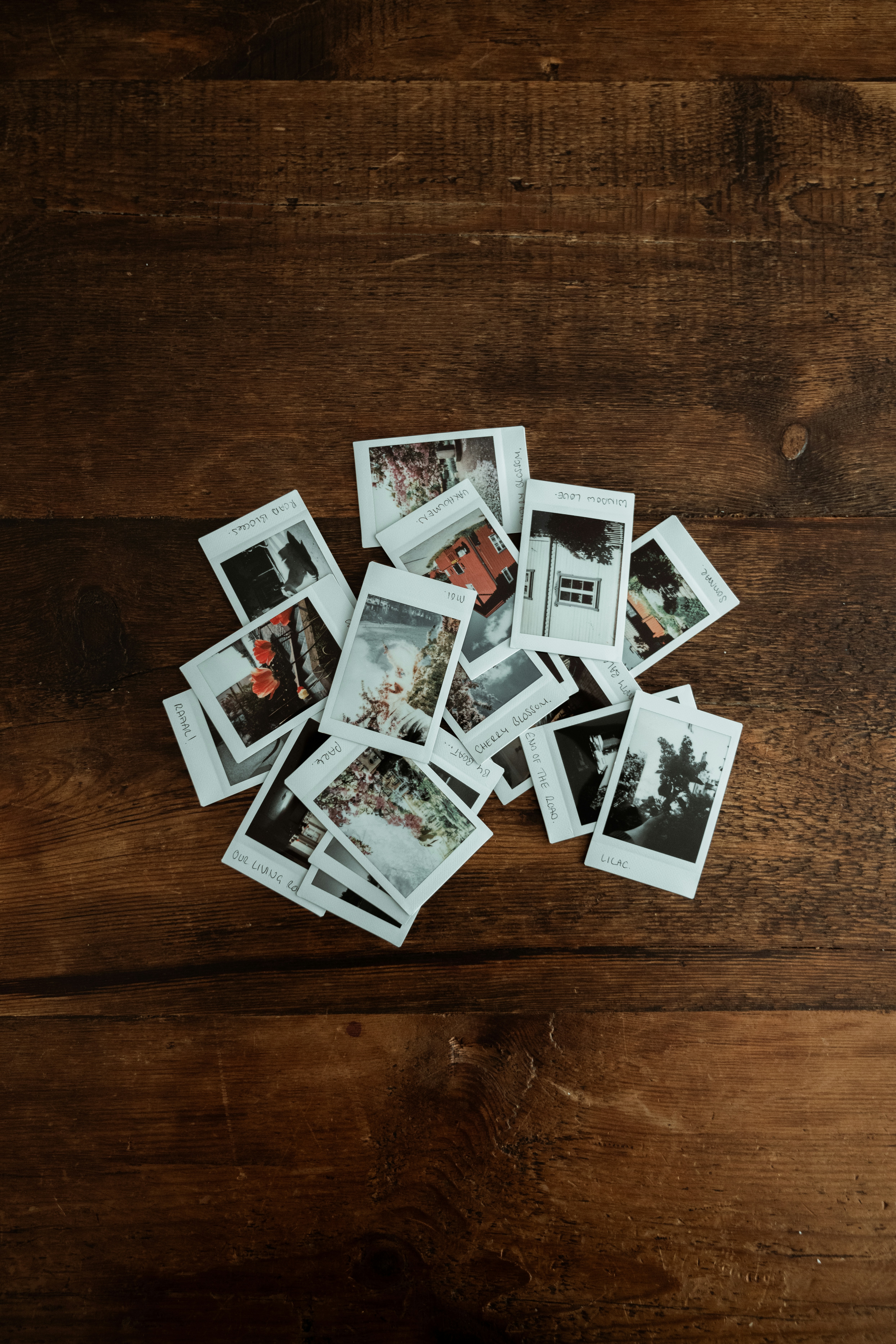
I think of my Poppa who had a point and shoot camera that he bought at a garage sale for $5. He was famous for never asking us to pose or smile at the camera, but would stand up, aim the camera in our general direction, and take the shot. We used to tease him about it – “Take the time to get us to look at the camera, Poppa! Don’t waste the film!” But maybe he had it right all along. The moment, as is, has its own worth and beauty.
If we begin to think about snapshots as a way of understanding our lives, something shifts.
A snapshot resists the urge to turn one moment into a permanent stain.
It refuses to let a single decision speak for an entire life.
It does not undo consequence or erase what followed.
But it changes the way that we hold the person who lived that moment.
And this way of seeing doesn’t stop with events. It becomes even more necessary when we move into the complicated terrain of relationships, where our ideals of who we should be collide with the reality of who we are.
Maybe that’s the quiet mercy we often miss;
You are allowed to see yourself in snapshots, not in permanent verdicts.
You don’t have to hate the earlier version of yourself who made a choice with information.
You don’t have to drag one moment across the canvas of your whole life.
In Part 2, we’ll stay with this idea of limits, but turn toward relationships — and how loving as humans, not ideals, shapes us, stretches us, and asks us to reckon with the gap between what we imagined love would be and what limited people can actually carry.
Stay tuned!
- 1) Gilbert, D. T., & Ebert, J. E. (2002). Decisions and revisions: the affective forecasting of changeable outcomes. Journal of personality and social psychology, 82(4), 503–514.

